Cuba is a communist nation. For those not familiar with the theory
behind communism, it basically operates under the theory that "the people"
own everything, and that the state will provide anything that anyone would
ever need, either for free, or at a minimal cost. Under such a system,
there is no personal property, since everything is shared by everyone.
Hence, one would never be "without.")
Property Ownership
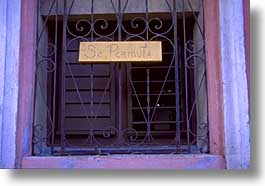
Windows that display the "Se Permuta" sign indicate that the flat, or
apartment (or house, in some cases) is available for exchange with another
house. Since Cubans cannot own property, they cannot "sell" their place
of residence. If you want to move, you "trade" your pace with someone
else's place. Since all people are supposed to be equal, you find any place
you like, agree with the resident to an exchange, and begin the lengthy and
time-consuming paperwork. But, since many residences are clearly not equal
(see the Houses page), exchanges of houses
usually involve cash exchanges as well (without knowledge by the authorities).
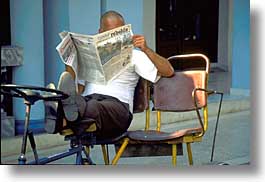
There are only two newspapers, the Granma, and the Rebelde, both run
by the government. The Rebelde has the reputation for being more
controversial, but it's not clear why; they are both so similar.
The Rebelde is in Spanish only, and is not distributed outside Cuba.
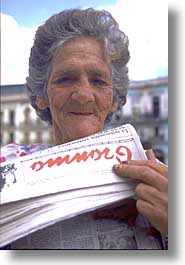
The word "Granma" comes from the name of the boat the Castro used to
return to Cuba after he was exiled in Mexico by Batista. Originally owned
by an American, the Granma still lives in a museum that is apparently
closed to all visitors. Many Cuban things and places are named "Granma",
including this state-run newspaper, which is translated into most major
languages, and is also distributed everywhere, including the USA. They
have a Web Page (www.granma.cu), whose content mirrors
that of the paper: Cuban political view of the world. As a US citizen,
I find it incredibly entertaining, because the propaganda is so
excessive. At the same time, it makes you step back and appreciate
just how different our views are from those with diametrically opposed
political ideas. I'm sure we sound equally excessive.
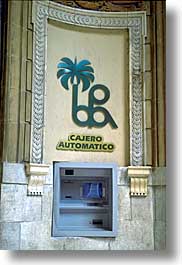
This is Cuba's one and only ATM, and it resides in Havana, next to one of
the branches of the country's one national bank. It doesn't take plastic
ATM cards as most westerner's think of them—they are more like debit
cards used in telephones. Most Cuban's don't own one—it's mostly for
the richer Cubans who manage businesses.
Borrowing money is possible, but you can only do so if you earn at least 300
pesos a month, and you have two co-signers for your loan. There is no interest
charged on loans, and you have from three to five years to repay it. Since most
Cubans earn about 200 pesos a month, and few earn more than that (except for
police, who earn about 800 a month), borrowing money is beyond most people's
capabilities. Even so, there isn't much to do with borrowed money anyway,
since one cannot "invest" it into an income-generating business, which would
be used to pay off the loan. The one exception to this is small family-owned
businesses, like restaurants and room-rentals, or even farms. But borrowing
money is not culturally accepted, and capitalistic economic models are not
very well understood. (Universities are just now beginning to teach theories
of capitalism, so change may come sooner than expected.)
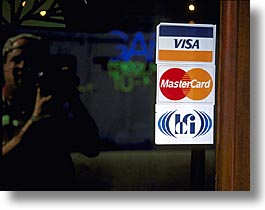
While Visa and Mastercard are accepted in some parts of Cuba, it is rare
and mostly found in hotels and other businesses that service tourism.
Since Americans are not allowed to "spend money" in Cuba, credit cards
issued by American banks don't work there. Americans going to Cuba must
take cash. (They also don't accept traveler's checks.)
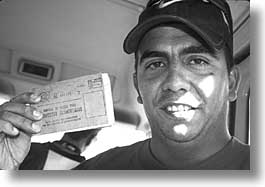
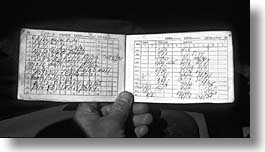
Every citizen has a ration book, which identifies food and other essentials
that people can buy at a substantially reduced price.
The ration book contains a list of items purchased, their quantities and
the dates of purchase. People are only allowed a certain number of
items, or weight thereof. Children up to the age of seven are guaranteed
milk, and families are allowed about 45Kg of meat per month. There are
harsh penalties for exceeding government-set allocation, even though the
maximums are only enough to last from 2-3 weeks. Supplemental provisions
must be obtained through "personal endeavors", or, entrepreneurship.
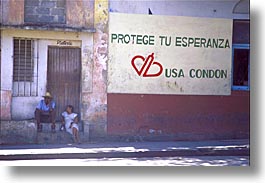
Cuba is probably best known for its medical infrastructure, and in that
spirit, the government has many pro-health educational programs that vary
from public awareness and education, to the administration of inoculations
and other free medical care for everyone. If one is found to have HIV or AIDS,
they are immediately moved to quarantined camps, which are purported to
be so extravagant, that the most destitute and desperate are said to try to
get HIV in order to improve living conditions.
Yet, despite the positive side of Cuba's health care system, the irony is how
the government subsidizes its tobacco and liquor industries, and is silent
about the perils of smoking and drinking. What else is not well known is
how the medical system performs when people finally get sick or require
hospitalization for some reason: most hospitals lack basic commodities, such
as sheets and pillows, and the nurses' and everyone else's smoking makes
breathing difficult in the poorly ventilated buildings.
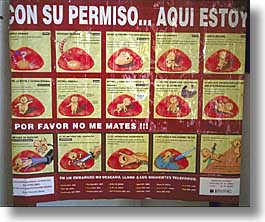
This anti-abortion poster graphically describes the development of the
fetus and how any form of abortion is the most offensive form of murder.
Such propaganda
is not common in Cuba, and is only allowed in churches, so such messages are
rarely seen. Nevertheless, abortion is rare in Cuba due to the promotion of
other prevention techniques, such as the use condoms and birth control pills.