|
Markers indicate locations for photos on this page.
Accuracy responsibility of Google Maps
Google Map Goes Here
If you see this text, the map is still loading (or there's an error). |
 Introduction
Photographing the night sky is extremely rewarding because you often get
views of things that your own eyes either can't see, or you don't think to
look for them. When seeing photos of stars, star trails, or other night
images, people are often surprised by the unreal—or surreal—colors.
They often think these photos are either fake or manipulated. While that
could be the case, what most people don't understand about light is that
the human eye doesn't discern between the chemical compounds that make up
light. Humans view a very narrow spectrum. Cameras, on the other hand,
can pick up light wavelengths that is composed of chemical compounds like
helium, hydrogen, and so on. These chemicals change the "color" of light
that that we can't easily see, but cameras can.
Because our everyday world doesn't have a lot of things that are heavily weighted towards these things, most everyday pictures that we take appear much like we see them in real life. But it so happens that stars in the sky are different—they are made up of gasses that are comprised of these chemical compounds that emit colors that we can't see, but cameras can. So, the "hues" you may see in photos of stars may appear vivid, but that does not mean it's been artificially altered.
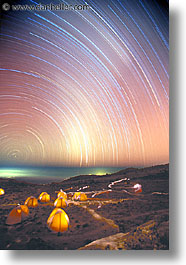
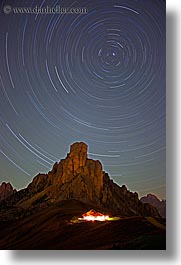
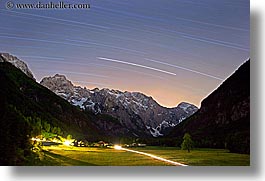
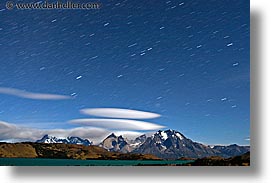
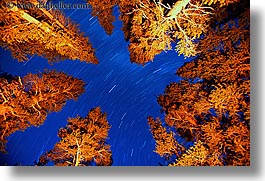
When photographing stars, you can either get a star "field," a static snapshot of the stars as points of light, or star "trails," where the stars' movements streak across the sky. How long you expose the image determines which you get. The first rule of thumb to remember is that the Earth rotates such that the light from a star begins to "move" after about 15 seconds. It's apparent movement is largely dependent on your lens—the longer the focal length, the more apparent the movement; the wider angle lenses won't show much movement till later because of the star point is so small. For comparison, a close-up photo of the moon can only be about 6 seconds before the Earth's movement blurs it. Part of your experimentation will be to gauge the timing for how much "trail" you want.
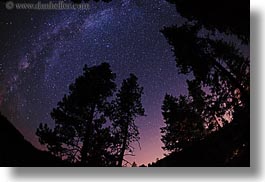
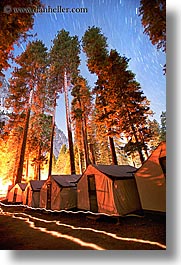
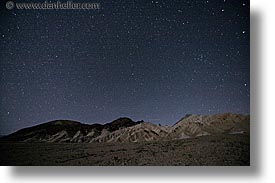
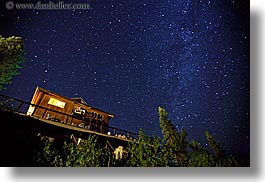
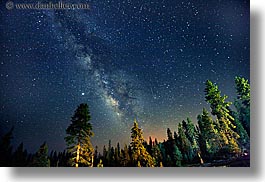
The above photos were taken at
King's Canyon National Park in California, with a
setting of 30 seconds at f2.8, using an ISO of 3200. The camera I used
is a Canon EOS 1DsMark3, however any camera that can do 30 seconds at
f2.8 should get pretty good results, provided the sky is cooperative.
A fun thing to do with these "still" photos of star feilds is to use
a cable release with an interval timer to take a series of consecutive
pictures and string them all together in a movie. In this case, I
created a video consisting of about 210 photos, each taken exactly the
same way. Since each exposure is 30 seconds long, the entire sequence took
120 minutes, or about two hours. Click on the photo to see the movie.
Once the individual frames are captured, you can use a variety of
editing tools to string them together into a video format, such as
Apple's iMovie program, which is included with the computer, or any number
of applications. Search for "movie editing software" on the net. All of
them can produce movies from still frames like this. I happened to use
a program called "FotoMagico" on my Mac.
The process for taking long exposures in a single frame is technically simple. You only need a camera that can has the "bulb" exposure setting, and a cable release. Generally, you set the camera on the widest aperture setting your lens can do, press the cable release, and go get coffee, or have dinner, or go to sleep. Many star trails pictures are hours long. Once you try this, you'll be instantly excited by the results. However, if you're like most people, you will also find you've made a few mistakes, or that the exposure didn't quite come out right, or that the focus is just a little soft, or that your foreground objects (not stars) aren't what you hoped they'd be. This is why this article goes on. To avoid many of the common mistakes with star trails photos, the main things to keep in mind are:
Picking a faraway place on a night with a new moon (or close to it on
either side) is best for getting the darkest skies, which make the
light from the stars is more pronounced. This may not be as easy as you
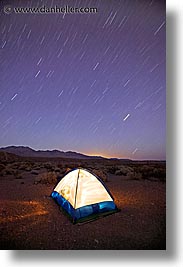
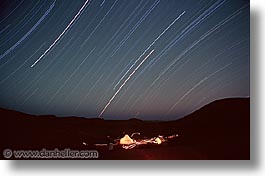
think. The photograph of the lit tents shown here was shot in Death Valley
(over 300 miles away from Las Vegas), which still had an illuminating
effect on the horizon. To illuminate the tent, I spent about 30 seconds
waving a flashlight around from inside the tent. This process is hard to
get right without overexposing the tent's fabric. Again, the benefits
of experimentation. This light also helped bring out detail on the ground.
On a perfectly dark nite under a totally new moon, you won't have much to see other than stars. With no other light at all—even the ambient light—you can't see other objects at all in the foreground, which makes for limited composition options. Here, it's common to get a silhouette of a tree or a mountain. Although it's also fun to use a flashlight to illuminate foreground subjects like a cactus. (I've even used the brake lights and turn signals from my car to create colorful red and yellow bursting effects on foreground objects.) Starting an exposure while a crescent moon is just about to set can illuminate the foreground enough to have them lit adequately, while permitting the exposure to continue (and get longer trails) as it gets darker.
In choosing foreground subjects, you'll need to make sure you get them
in focus along with the distant stars, which often requires smaller
apertures. This works against you because the smaller aperture means less
light. Alas, your composition has trade-offs: composing a scene that can
uses a wide aperture, but still has interesting foreground subjects.
Generally, I compose scenes that have the closest subject to the lens
be at least 10 feet in front of me, if not further. I also use a wide
angle lens, so that I can get everything in focus at or f3.5 up to f5.6.
I try to avoid apertures greater than f8, which can yield a reasonable
picture if exposed for several hours or more. Again, I don't want to
raise my ISO setting, because the digital noise becomes intolerable.
However, doing so is a good way to experiment, and get a prototype of
what your composition will look like for a longer exposure at a lower ISO.
At this juncture, you must now experiment and rely on trial and error to learn the ropes. Just compose what you might think would work, release the shutter, and go get coffee (or go to sleep).
It's tempting to want to use a higher ISO setting to brighten photos due
to the lower light conditions, but the side-effect of higher ISO is higher
noise. I use ISO 100 to keep the "digital noise" down, which is more
pronounced in darker areas of an image than lighter ones. Your mileage
may vary, as different camera manufacturers deal with noise differently.
Even though some cameras may perform better than others, all cameras will
produce much better images at lower ISOs than higher ones.
Almost any film-based SLR will expose long enough because battery consumption is low. But digital cameras have a tougher time because digital sensors eat power. Most consumer-brand cameras won't do much more than about an hour or two on a single charge, but that gets better as technology improves over time. You'll have to experiment. Higher-end ("prosumer") cameras can do much better, but on those cameras, there's another factor: noise reduction. Long exposures often cause the camera to take a second "dark frame" (internal) exposure for the same amount of time as the first exposure, which it then uses as a mask to cancel out the noise. You don't do this yourself—the camera does it automatically— but it means that a 1-hour exposure requires 2-hours of battery life to process the photo to the end. So, if you're going entirely from battery power, you may be limited. To get more images in less time—and to make the most of battery power if you're not using a power adaptor—opt for simpler night pictures of shorter star trails, or just star fields. As stationary objects, it's still a pretty amazing site. For those using pro-level Canon equipment, I can vouch for my 1DsMark3 and 5DMark2, each of which will easily do a 2+ hour exposure, plus the added 2nd "dark frame", on a full battery charge. I can't speak to other camera models or brands. If your camera comes with an direct AC power adaptor that allows you to plug the camera in directly to the wall, you don't have a problem with power. However, it means that your location is limited to one that has proximity to an outlet. To optimize this flexibility, get one of those 100-foot long extension cables at a home supply store or even drug stores. Not all cameras have such an adaptor—especially the lower-end consumer brands—so if you're in the market for a new camera, be sure to look for this.
When staying in hotels, I often choose rooms that face towards the darkest
part of the sky and that have the least amount of ambient light (usually
the decorative hotel lights). This way, I plug into the wall, and place
the camera (on tripod) either on the balcony, or shoot through the window.
When camping, I use an AC power adaptor plugged into the car or a nearby
power supply. (A house, cabin, etc.) Obviously, this may not always be
possible. In this case, true night-photo nuts go out and buy generators
or battery packs that can keep a good exposure going for quite some time.
 More to See
For a complete list of all star trails shots on this site, go here.
Click to recommend this page: |
|
 Time-Lapse of Milky Way over Idaho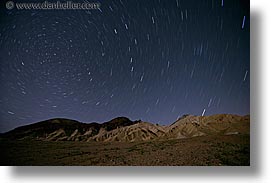
 Photographing Star Trails