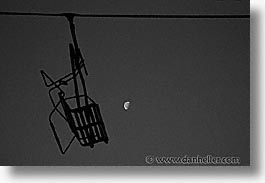
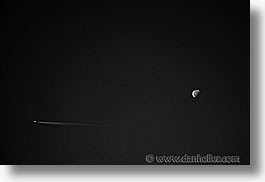
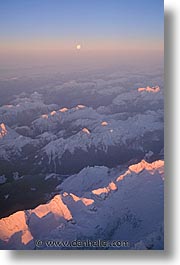
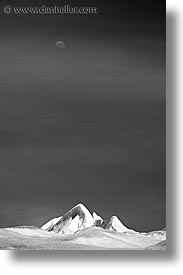
|
Markers indicate locations for photos on this page.
Accuracy responsibility of Google Maps
Google Map Goes Here
If you see this text, the map is still loading (or there's an error). |
 Introducton
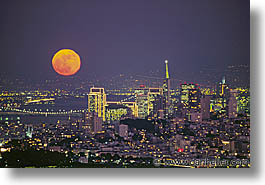
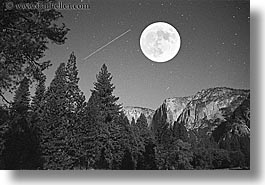
Most have had the experience of photographing what appears to be a beautiful night scene with a full moon hovering over a city, but after they get their photos back, the moon is but an overly bright "spec" in the sky. What happened? There are two problems that must be overcome. First, there is a problem of proportion—the moon appears much smaller than it does to your eye. And the second problem is that of exposure—the moon is overexposed because it's so much brighter than the rest of the scene.
This article will address these subjects and a few others. But it should
be pointed out that this only applies to shooting with film. Digital
cameras don't do double-exposures, which are necessary for the methods
described here. I'll address the digital aspect later, but it needs to
be pointed out up front so you don't go off trying this with your digital
camera only to find you can't. (And, there are better/easier ways to do
this digitally anyway.) There are two aspects to the task, however, which
are shared by digital and film: optical perspective compensation, and
and exposure settings. So, let's get started.
All this suggests that there should be a "middle length" lens where the
aspect ratio of all the objects matches what you see when you look at
the scene with the nake eye. Well, the problem is what you think you see
has been manipulated by your brain to adjust for the anomolies and other
light refraction that the lens in your eye causes. Thus, the challenge
for making a scene appear "real" in a photograph requires applying the
same sort of technical manipulations that your brain does. The technical
solution to this problem conveniently solves the second challenge of
shooting the moon at night. Namely, setting the proper exposure. So, we'll
kill two birds with one stone.
So, how can you solve both problems at the same time? That is, how
can you get the dark night scene to expose propertly and get the bright
moon as well? And all in the same photo? For film, this is accomplished
by shooting a double exposure. That is, two pictures in the same frame
of film. One exposure captures the scene with the appropriate lens
(for composition) at the appropriate exposure settings, and the other
exposure captures the moon itself (with possibly a different lens) at
its appropriate exposure setting. What isn't obvious is that, in each
exposure, you don't want to capture any part of the other. That is, when
you shoot the "scene", you don't want the moon in it at all, and when you
shoot the moon, you don't want anything else in it but the the dark sky.
 Putting It All Together
Once you know when to go, now you need to get your equipment together. Start with a camera that can do double exposures, which most SLR cameras can do. Point-n-shoot cameras, disposables, digital cameras, and other "automatic" cameras usually can't do this. Check your camera's user's guide if you're not sure. (If you're shooting digital, you can do this digitally by placing a photo of the moon inside another photo, but my experience has been that this doesn't look as "authentic" as a real double exposure, which makes for more consistent lighting.) Next, you should have the following things besides your camera—a flashlight (always overlooked by the beginner); a tripod, preferably one with a quick-release since you will be putting the camera on and off of the tripod a lot; a cable release, or a camera that can expose on a self-timer for up to 30 seconds without your having to keep your finger on the shutter release; and either a zoom lens that can go from 28-105, or two separate lenses that span at least those focal ranges. For best results, you may want a telephoto lens up to 300mm, in case you want to put a really big moon into your scene. Once you've got these organized, wait till the sky it pitch black around where the moon is (assuming there are no clouds immediately around it), then it won't affect the first exposure. (We'll discuss dawn/dusk moon photography later.) Your first exposure will be on the tripod using a "wider" lens to get the scene. The second exposure will be a quick hand-held shot with a telephoto lens where there is nothing in it but the moon. (This is why you need to zoom in.) Remember, the aspect ratio of the moon in a wide angle shot is such that it will appear unrealistically small if you use the same focal length for the moon as you used for the "scene" picture. Of course, you can go to the other exreme and zoom in too far, but that's a creative choice you may want to experiment with. (You've got a whole roll, experiment!)
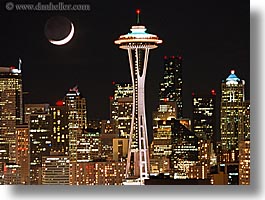
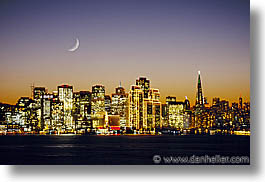
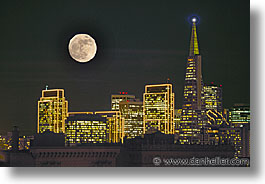
Once your composition ready, take the first exposure. The duration will vary on the lighting as discussed above, but you will probably want to use your cable release to keep the shutter open, unless your camera has an automatic timer. Many SLR's go up to 30 seconds, which is usually sufficient for a city scene, like those shown on this page.
For various creative effects, you can change the size of the moon with your lens by zooming in or out, depending on the look you want to give, but the most common mistake it putting the moon in a part of the frame that overlaps with the other stuff you've already shot, so be careful. The exposure setting on this image is usually around 1/250 second at f4.5, or f5.6. It often varies on certain atmospheric conditions and your film speed. The faster the exposure, the more detail in the moon you'll see, but it'll also be darker.
By the way, notice the difference in exposure between the 1/250 second
and 8 minutes! Each of these are the proper exposures for capturing
detail in their respective scenes, so it should be clear now why you can't
shoot both the moon and the scene in the same shot when it's dark.
The techniques discussed here require a little practice because of the
propensity to overlook a step, as noted before, so expect to go through
various rolls of film when you get started. You should also experiment
by varying the exposure and zoom level on the moon itself, till you get
a feel for what you like. I happen to like an overly enlarged moon because
I think it's so over-the-top silly and ridiculous, which appeals to my
sense of humor. For some, it can to their sense of wonderment, especilly
children. It's admittedly rather tacky, but again, it's fun to experiment.
You may also try multiple exposures, like 3 or 4, and see how many moons
you can get in the same shot. here, you can also vary the size of each of
the moons to make it look like the Earth has many in orbit.
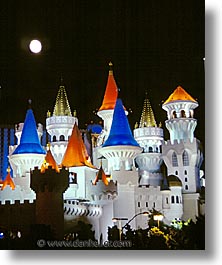
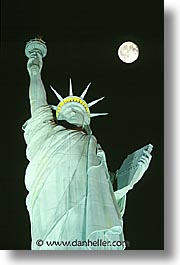
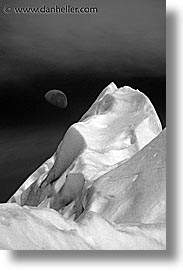
For a complete list of all moon photos on this site, go here.Below are some random samples
Click to recommend this page: |
|
 Optical Perspectives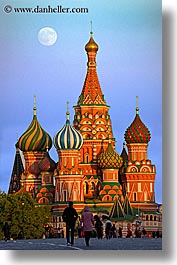
 Proper Exposures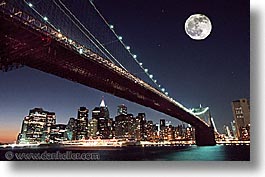
 Film
Film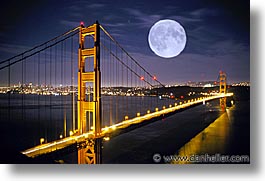
 A few notes on day-shooting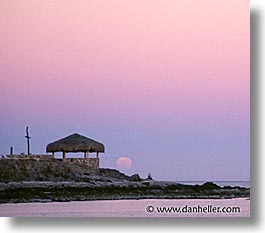
 More to see