|
Click to recommend this page:
| |
 Introduction
We'll start with an old joke:
An old man excitedly makes his way into a confession booth at the cathedral in
a small town, trembling in anticipation. He speaks quickly,
"Father, I am 83 years old today, with three children and eight wonderful
grandchildren. I was married for 60 years, until my dearly beloved died
two years ago. But last night, I had a date with two beautiful 18-year
old girls!"
The father replied, "How long has it been since your last confession?"
"Never," replied the old man. "I'm not Catholic."
"You're not Catholic? Why are you telling me this?"
"Father," the man said in a high-pitched whisper, bursting with excitement.
"I'm telling everybody!"
It's funny about "digital manipulation" of photographs. People take almost
a religious attitude about the immorality of it, scorning how evil it is
to alter the true, pure and honest representation that a photograph depicts
of the real world. Some people will actually get upset if they think an
image has been digitally altered, working themselves into tizzy, stating
authoritatively, "That image is FAKE!", as if they've caught the
photographer in the act of the eighth deadly sin, just in between "envy"
and "pride." Over time, almost every photographer will eventually get the
accusation, often in a mean-spirited and condescending tone, similarly to
how prosecutors cross-examine defense witnesses. I imagine the following:
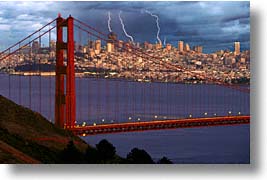
"Isn't it true, Mr. Heller, that you intentionally placed the lightning
in your otherwise generic photo of the Golden Gate Bridge?!"
I'd answer, "Why, yes I did. What's more," I'd continue, as if from a
1950's "B" film, "I'd do it again, dammit!" The gasps from the halls
echo in the court-room chambers.
For the most part, I rarely do this. (Nor do I act in "B" movies.) Why?
Because it's very hard. (The digital manipulation, not the acting in
"B" movies, which I don't do anyway.) Digially editing images well is
insanely time-consuming to do well. I highly respect those who can
do it; I don't scorn it. In fact, it's an art form in and of itself.
Don't get me wrong—it's not that I don't do some digital editing of
photos. I do. Every pro does. You have to. But, the question is, where
is the line between proper "fixing" and outright "lying?" The problem
has become that the purist photographer has scorned the mere mention of
an altered image that we're all throwing the baby out with the bathwater.
 Philosophically Speaking...
While only some people get really upset about digital manipulation, most
don't really care that much, unless they feel they are being lied to about
something important. But let's understand a little about history. Back in
the earlier part of the 20th century, there was a group of now-famous
photographers that called themselves the "f64 Club," who prided themselves
on the fact that they shot pictures at f64 to get the sharpest possible
photos possible. Why was this unique? Because in those days, photography
wasn't considered an art form unless photographers manipulated their
photos in the darkroom to "blur them up" so they would look more like
paintings. Photography, it seemed, was "too perfect" for the critical
art world, so to be considered valid, your photos weren't allowed to
be too sharp. The f64 club was a small group of mostly San Francisco
photographers that challenged the idea and went against the grain by
making incredibly sharp photographs. And, well, the rest is history.
When people like Ansel Adams popularized photography for the common person,
his idea of "the perfect negative" was coined. However, the interpretation
of his meaning was misconstrued to imply that it is a photo that needs
no manipulation. Yet, this was never his intent; instead, it was
so named to reference a negative that was shot according to his now-famous
Zone System—a calculation of light and exposure settings that took into
account the properties of film so that you would intentionally over- or
under-expose an image to make darkroom manipulation easier. This was
deemed as the best way to yield a more perfect print. As Ansel Adams
himself said, "the film is the score, but the print is the performance."
This tenacious grip on the truly perfect picture as the only true form
of photography got further reinforcement by flagrant distortions of truth
with less than altruistic purposes in mainstream media, ranging from the
OJ Simpson "blacker and black" photo on the cover of Time Magazine, to
the National Geographic fiasco, where a photo of pyramids in Egypt was
altered so to get all three of them to fit on the cover of the magazine.
There are several issues to address. The first thing is a matter of
trust, and the second is a matter of artistic expression. Unfortunately,
people are moving towards non-acceptance of aesthetic unless it's been
accompanied by truth. So, the question then becomes, "What is truth in
photography?" Or, put another way, "What is Pure Photography?"
Back to the question that started all this:
"Was the lightning really over the Golden Gate Bridge, or did I put
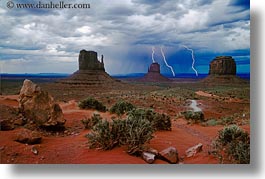
it there?" In this case, I put it there. I got the lightning from my
series on Monument Valley. (The original photo
from which I "stole" the lightning is shown here.) The fun part about
this story is that I was accused of digitally enhancing another photo
(sunset photo shown above), and I decided to do a real digital
enhancement to illustrate the point. No sooner did I finish doing the
"lightning over the Golden Gate Bridge" photo did I get an angry email
from someone saying,
"You faked that picture! You're a liar and a cheater!"
It's important to realize one fact about photography (in any its forms,
film and/or digital): to get a photo to render real life, one must
do a certain amount of manipulation. The reason is a simple matter of
science: the technical limitations in film, digital sensors, scanners,
photo paper, and even computer monitors, mean that reproduced images
cannot match the range or quality of light that nature produces in real
life. Therefore, it becomes the burdensome task of the photographer to
work within technical limitations to render something that approximates
light. And, this is where the tricky stuff lies and where people part
on their opinions.
Still, it's an artistic expression, and there's not a whole lot
of discussion one can have on that topic, since it's so subjective.
I happen to feel that photography is another form of art like painting,
and I judge it solely on whether the artists' expression talks to me.
Ironically, one can have a similar discussion with art critics, who
feel that painters who so precisely match reality so as to look like a
photograph are somehow a notch below other, more "impressionist" artists.
What is this world coming to?
One can easily raise their hand in protest and say, "Color-correction
to match reality is one thing, and even more abrupt adjustments for
creative expression is another, but these are hardly comparable to
placing objects in the picture that weren't there." Yes, true.
Unlike artistic expression, photography does have a different aspect
to it, in that it does capture reality, and it can be used for more
purposes than to just show a pretty picture. It can move people to fight
wars, to vote for a candidate, or to buy products. This is old news; I
don't need to get into this. But, the question then becomes, is a photo
being manipulative, or is it telling the truth? What an odd question,
because a "truthful" photo can just as easily manipulate opinion as an
altered one. If you see a photograph of a large crowd of people protesting
a women's clinic with anti-abortion signs, you might get one opinion of
the public's view on the subject. But, what if the photographer used a
wider angle lens to show that the crowd wasn't so big afterall, and that
they were only bunched up together so as to give the impression of a
large group for purposes of the photo. Gives an entirely different
impression, doesn't it? Is this form of manipulation any different than
if the photographer digitally cropped out the empty space where people
weren't so as to give the same impression?
Photography has always suffered from the comparison of what the picture
shows versus what reality shows. As its use as a tool for journalism
grew, the expression was coined, "the camera doesn't lie." However,
with that came an unfortunate misperception that the camera is somehow an
objective, truthful window to the world. This fallacy was never intended,
and has become like an albatross around the neck of the entire photography
world due to the public backlash and distrust when people consider the
possibility that a photo has been digitally altered.
 What is Pure Photography?
The final version of an image is the one that is displayed to the viewer,
not the film itself, or even the camera's role in it. When a photographer
uses a conventional darkroom to adjust photographs to make them print
"correctly," this has always been accepted as part of the photographic
process. In fact, it's respected and admired. The film is an
intermediate step to getting to the final print. In fact, it has only
been since the introduction of the digital image did the "fundamentalist"
movement begin in photography. In the days of the darkroom, no one ever
asked whether an image had been "manipulated." Today, computers make
the same darkroom tasks more efficient, where you can do a lot more than
what used to be possible in the darkroom. So, people now have a distrust
about what they see, and only respect those images that they feel are
free from alteration.
So, answer the question, already: "What is pure photography?
It just keeps getting more complicated, doesn't it?
People refer to it as pictures that most accurately convey what the
scene really looked like, as if you were standing there alongside the
photographer. That's more about photo "journalism" a single aspect of
the much wider spectrum of photographic expressions. But, even in
photojournalism, "distorting the truth" is what photography is all about.
One man's truth is another man's "spin."
Ok, so instead of asking "what is pure photography?", let's ask the more
pertinent question:
"What exact point along that spectrum of distortion lies the division
between an acceptable representation of reality and an unacceptable
distortion of truth?"
Some people think that "setting up" a photo (i.e., a non-candid photo)
is more of a lie and manipulation than any other kind of photography.
And there are lots of famous photos that have been later learned to be
"set up." Such as the sailor kissing the girl on a busy street in France,
or the famous shot of the American soldiers putting up the flag after
they defeated the Japanese at Iwo Jima.
 Photography as an Art Form
I guess it's that I'm not so much of a purist that I care about such things.
Photography is an art form not unlike painting. The objective is to present
an image that evokes mood and feeling, or tells a story, or whatever it is
that the photographer sees, or intends us to see. To me, photography as
an art form takes on a new and different role: intent.
There are two schools of thought on the topic of "intent." One says that
if any art form evokes an emotion or any kind of (dramatic?) reaction,
then it's achieved its purpose as an art form. I'm not so generous, since
vandalism accomplishes that, and few consider that to be an art form. So,
I am a member of the other school of thought that promotes the idea that
the artist has to have something in mind, and that intent needs to be
conveyed to the viewer.
When I'm asked to view people's photos, an overwhelming percentage of
photos suffer from a lack of one thing or another: intent, or
communication of that intent. A moderately trained eye can see if
there was an attempt made at intent; but an untrained eye can immediately
say whether it was communicated well. That, of course, is the very litmus
test!
More often than not, people shoot pictures and put the unaltered
"result" on their webpage or in a portfolio presentation. Assuming the
pictures are any good in the first place, they are usually missing
the dynamic capabilities they deserve. It's like taking a score from
a Bach sonata and feeding it to a player piano; it'll play the notes,
but doesn't express the "feeling." Again, Ansel Adams:
"The film is the score; The print is the performance."
In his world, that was the darkroom. Today, it's Photoshop. Digital
editing isn't cheating, it's the modern darkroom; it's how you breathe
life into a photo. Film and/or digital sensors don't nearly have the
dynamic range of our eyes, so you need to bring that sense of reality
(or "expression") back into the image using image editing tools. In short,
make ME see what YOU see; make me feel what you feel; help me understand
what drives you. Or, to put it more placidly, "What is it about that picture
that made shoot it?"
Those who put raw pictures online either appear scared, or as a politically
"purist", opposed to digitally editing their work. Granted, some
shots are great "as is," and in those cases, don't touch them.
Not every shot needs editing. But most do. My advice: pay close attention
to your intent: bring up details that otherwise fade to black or
burn out in the whites; "calibrate" colors in those scenes (night,
sunsets, etc.) to render the true essense of what you felt when you
saw it. If you took a picture that has a lot of sky in it, ask yourself
what's interesting about it that prompted you to keep all that sky? Now go
emphasize it. Use dodge/burn techniques (just like in the darkroom), and
bring out contrast. Make those clouds punch. Similarly, if the image is
about color, draw it out. If someone says, "crop it," it's a sign that
you're not conveying what YOU thought made the "bigger" version of the
picture interesting.
At this point, I encourage you to read the second part of this article,
Responsibilities of Photojournalism.
Click to recommend this page:
|
|